
Candy crush
Japan’s Morinaga and other international companies discover that North Carolina is a sweet spot for making candies and snacks.
Challenge: International companies need to establish North American hubs to meet increasing demand for their products.
Solution: Local and state leaders unite to provide top-notch, individualized service while promoting North Carolina’s attractive business climate.
By Mike Purkey
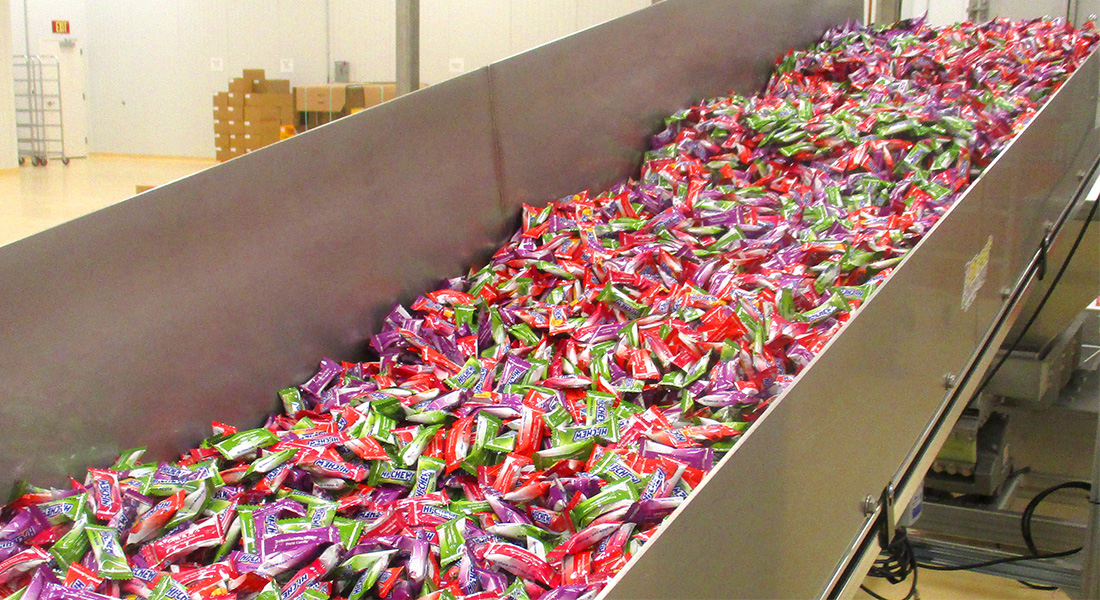
What once was a hard-to-find candy with a cult following is now moving into the mainstream, thanks in large part to a new factory in North Carolina. Candymaker Morinaga & Co. is the creator of Hi-Chew, the No. 1 candy in Japan for years. The company in 2015 built a plant in Mebane to meet increasing U.S. demand for the fruit-flavored candy. It’s part of a growing cluster of global food companies that have chosen North Carolina for their U.S. manufacturing and distribution operations.
Tokyo-based Morinaga started selling its confections in the U.S. in 2008, when it opened a marketing office in Los Angeles. While global sales total about $1.8 billion, the company at first struggled to compete with legacy candy manufacturers in this country, such as Skittles-maker Mars Inc. and The Hershey Co. That all changed when Hi-Chew found its way into a Major League Baseball bullpen.
Japanese pitcher Junichi Tazawa in 2009 signed with the Boston Red Sox, and because he was a rookie, his job was to keep the bullpen stocked with bubble gum. In addition to supplying gum, Tazawa, now with the Miami Marlins, introduced Hi-Chew to the Red Sox pitchers and soon, many players were scouring Asian stores looking for the chewy candy. A sponsorship in 2012 led to advertising in Boston’s Fenway Park, then other Major League teams — and their fans — began clamoring for Hi-Chew. The company says U.S. sales doubled the following year.
That growth led to a decision to build a U.S. manufacturing plant, prompting a search that included visits to Atlanta; Philadelphia; Portland, Ore.; Richmond, Va.; and Ontario, Canada. In North Carolina, the company looked at 18 sites in 12 counties before deciding on Mebane.
A site near Atlanta was in an established business park, with infrastructure and tenants in place. The favored N.C. candidate was a 21-acre site in Mebane’s largely undeveloped Buckhorn Economic Development District. Though more costly than the Atlanta site, Mebane won the bid through a package of economic incentives and the assistance of Steve Brantley, director of Orange County Economic Development.
“The [Japanese] culture demands perfection,” Brantley says. He developed a working knowledge of the language and customs of Japanese businesspeople during his 23 years working in economic development for the state. “They don’t like unforeseen surprises. If they can find someone they can really trust, the more credibility you have with them, the more they listen to you,” he says.
Kyoichi Okamoto is president and chief executive officer of Morinaga America Foods. “North Carolina’s persistent service and problem-solving — and little things like picking us up at the airport and seeking out authentic sushi — gave us peace of mind as we made our decision,” Okamoto says. “It’s their way of doing business. And it’s an attitude that continued long after we signed on.”
The N.C. Department of Commerce awarded Orange County a Community Development Block Grant of $750,000 to cover 75% of the costs for water and sewer extensions. The county pitched in $250,000 for the other 25%. PSNC Energy, the Gastonia-based unit of SCANA Corp., extended a natural-gas line, and Charlotte-based Duke Energy Corp. delivered electrical power lines to the plant, both at no cost to either the county or Morinaga.
Other incentives included a grant from the One North Carolina Fund for $264,000, contingent on the company adding at least 90 jobs and investing $48 million over three years. Durham Technical Community College pledged $150,000 for workforce training at its nearby Hillsborough campus. The county put up performance grants, which could range from $1.1 million to $1.5 million over five years. And the city of Mebane contributed a performance grant of 1.5% of the company’s capital investment, up to $720,000.
The Mebane site is adjacent to Interstate 40/85, which appealed to the company for exposure and easy distribution. “It was no small task to open a business in a foreign country, to understand all the requirements and culture, but North Carolina offered a great site, overwhelming support and an overall climate that made this a perfect fit,” says Toshiaki Fukunaga, a senior executive officer at Morinaga & Co.
By August 2017, Morinaga said it had reached its hiring and investment goals. Because Hi-Chew sales are robust — the candy is in Walmart, Costco and some leading grocery chains — Morinaga is considering an expansion. The Mebane site has room for two more plants.
“I think it’s like a lot of international companies that eventually move some type of production here to the United States,” says Christopher Chung, chief executive officer of the Economic Development Partnership of North Carolina Inc. “They initially start off by exporting products into the U.S. market, and at some point, the sales grow to a level where it logically makes sense to put production here. Not only to be able to better respond to the customer demand from those growing sales, but also it can be a bit of a hedge against things like currency fluctuations.”
Historically, North Carolina’s manufacturing sector was reliant on textiles, furniture and tobacco. Today, the field is more diverse, with the food-processing and food-manufacturing industries employing 62,000 people in the state. Candymakers and snack companies are part of that growth.
Nitta Gelatin N.A. is a Morrisville-based provider of gelatins for the food and pharmaceutical industries. A division of Osaka, Japan-based Nitta Gelatin Inc., the company operates a plant in Cumberland County that gets its main ingredient from the hog-processing plants in eastern N.C. Gelatin is one of the ingredients in candy-making.
Belgium-based Lotus Bakeries said in December 2016 it plans to build its first U.S. plant at a 30-acre site in the North Carolina Industrial Center in Mebane. The company will make its Biscoff brand of shortbread cookies, popular with airline passengers.
Lotus had narrowed its finalists to two sites in North Carolina and one in South Carolina, says Mac Williams, president of the Alamance County Chamber of Commerce. Lotus plans to create 60 jobs and invest more than $48 million by the end of 2020, aided by a performance-based grant of up to $180,000 from the state and $2.9 million in local incentives.
Stormberg Foods, a South Africa-based snack-maker that doesn’t distribute in the U.S., chose Wayne County in eastern N.C. for its first domestic production plant. Stormberg plans to invest $2.5 million near Goldsboro as it studies the launch of U.S. sales. The company makes biltong, a meat-protein product similar to beef jerky.
“North Carolina has long been home to one of the most attractive business climates in the U.S., for not just American businesses but also foreign-based companies,” Chung says. ”Foreign-owned establishments now support more than 250,000 jobs in North Carolina, which is just one proof of that point.”
Jobs supported by foreign direct investment in North Carolina increased 24% from 2011-15, according to the latest data available from U.S. Bureau of Economic Analysis, higher than the national increase of 20%. Almost 120,000 N.C. manufacturing jobs are related to foreign investment, about 25,000 more than in 2011.
That number could grow if Morinaga America reaches its goal of increasing U.S. sales by 400% over the next five years. New packaging and more visible distribution channels could rev up the candymaker’s expansion plans.
With more Americans liking Hi-Chew, that would be a sweet deal.